
Applying unimodal models to high-performance bimodal air filtration membranes
Abstract
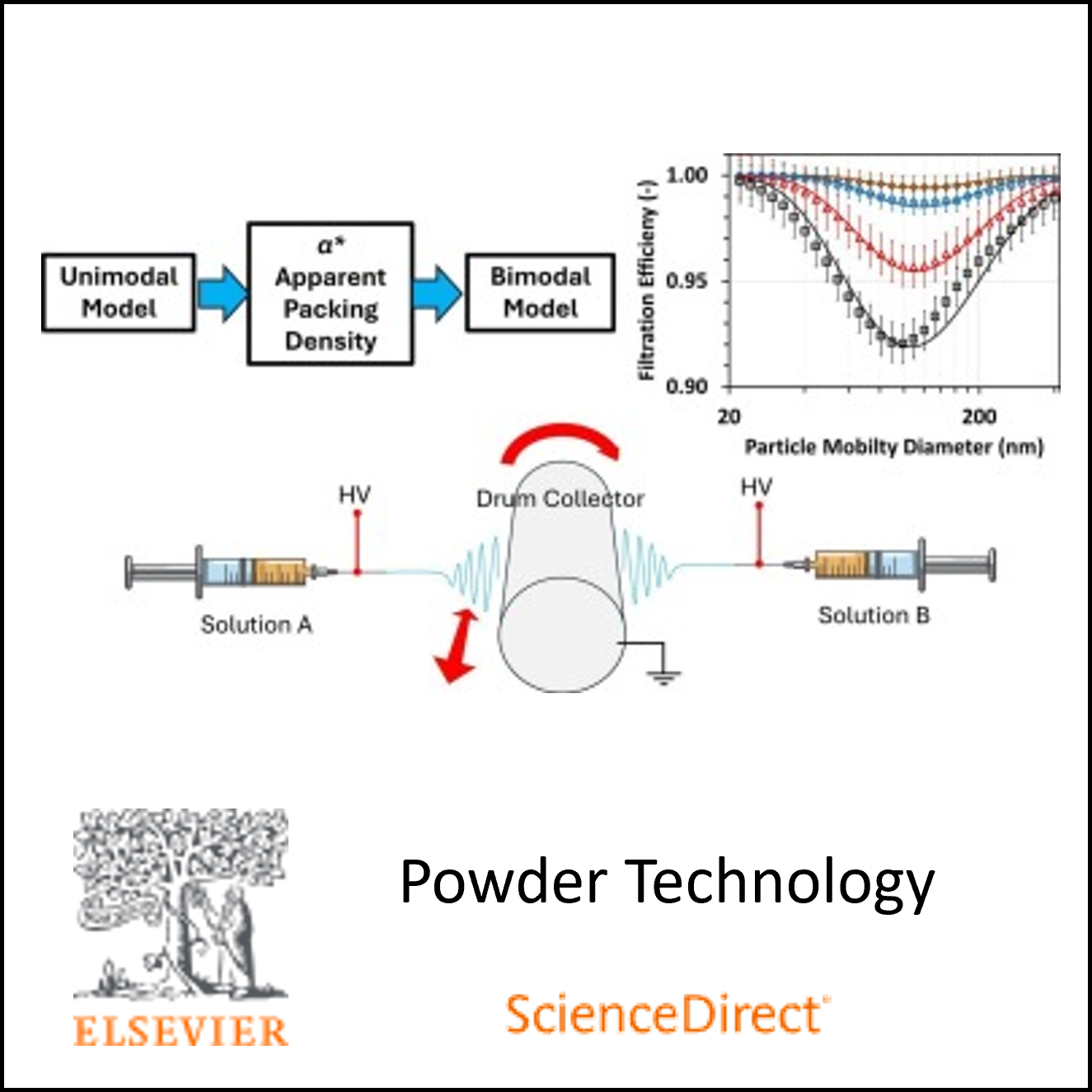
Nanofiber-based air filters are promising for efficient particulate matter removal, yet the use of unimodal models in bimodal fiber systems remains limited. This study examines electrospun nanofiber filters produced from polyacrylonitrile (PAN) in N,N-dimethylformamide (DMF) at 12 % w/w (Solution A) and 7.5 % w/w (Solution B), yielding coarse and fine fibers, as well as their bimodal composites (AxBy and BxAy) reinforced with nylon mesh. Scanning electron microscopy confirms that Solution A generates thicker fibers, influencing filtration performance. Pressure drop and filtration efficiency were evaluated across face velocities (0–25 cm/s) and particle sizes (10–500 nm) using established models (Brown, Davies, Ogorodnikov, Lee, Bian, Lee & Liu, Liu & Rubow, and Payet). To extend unimodal models to bimodal systems, a new parameter—apparent packing density—was introduced. Results show that the Bian model accurately predicts pressure drop (errors within ±5 %) by accounting for slip flow, while the Liu & Rubow model best fits filtration efficiency (errors within ±5 %), especially near the most penetrating particle size (MPPS, 100–200 nm). Incorporating apparent packing density enables precise predictions for bimodal membranes. Furthermore, composite fiber fractions significantly affect quality factors and MPPS, revealing trade-offs between efficiency and resistance. Overall, bimodal composites demonstrate superior performance, combining lower pressure drop with high capture efficiency. This study identifies the Bian and Liu & Rubow models, when applied with apparent packing density, as the most suitable approaches for bimodal nanofiber membranes, providing guidance for the design of next-generation air filtration systems.